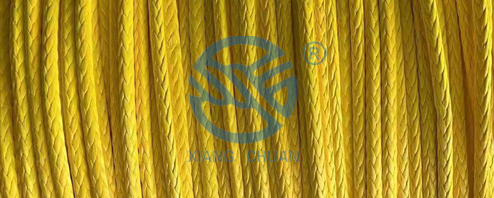
Double Braided Rope, also known as braid-on-braid rope, has established itself as a versatile and reliable choice across numerous industries, from marine navigation and outdoor recreation to industrial lifting and agriculture. Distinguished by its unique structure—an inner braided core wrapped tightly by an outer braided sheath—this rope type outperforms traditional options like 3-strand rope in multiple aspects. But what exactly are the core advantages that make Double Braided Rope the preferred selection for demanding applications? This article explores the structural, performance, and practical benefits of double braided rope, analyzing how its design translates to superior functionality, durability, and adaptability in diverse scenarios.
The fundamental advantage of double braided rope lies in its balanced structural design, which delivers exceptional strength-to-weight ratio and load-bearing stability. Unlike 3-strand rope, where fibers are twisted into strands that can unravel under stress, double braided rope features interlocked inner and outer braids. The inner core bears the majority of the load, while the outer sheath protects the core from abrasion, UV radiation, and chemical damage. This symbiotic structure ensures that the rope distributes tension evenly across all fibers, minimizing stress concentration points that often lead to premature failure. For instance, nylon double braided rope with a diameter of 12mm can achieve a breaking strength of 5,000kg, while weighing 30% less than a 3-strand rope of the same strength, making it ideal for applications where portability and load capacity are critical.
Another key advantage is its superior flexibility and handling performance. The braided construction eliminates the stiffness associated with twisted ropes, allowing double braided rope to bend easily around pulleys, winches, and cleats without kinking or forming permanent creases. This flexibility not only simplifies installation and operation but also reduces wear on both the rope and the equipment it interacts with. In marine applications, for example, double braided rope can be quickly tied into secure knots (such as bowlines or cleat hitches) that hold firm under dynamic loads, while its flexibility prevents it from damaging boat hulls or deck fittings. For climbers and arborists, this pliability ensures the rope conforms to the user’s movements, enhancing safety and comfort during ascent and descent.
Double braided rope also excels in abrasion resistance and durability, thanks to its protective outer sheath. The outer braid is typically woven from high-tensile fibers with enhanced wear resistance, such as polyester, polypropylene, or a blend of synthetic materials. This sheath acts as a barrier against friction from rough surfaces, saltwater, sand, and other abrasive elements, preserving the integrity of the inner core. Unlike 3-strand rope, where individual strands are exposed to direct wear, the double braided design ensures that damage to the outer sheath does not immediately compromise the rope’s load-bearing capacity—providing a visual warning of wear and extending service life. Tests show that polyester double braided rope maintains 80% of its original strength after 500 hours of abrasive contact, compared to just 45% for a similar 3-strand rope.
The versatility across materials and applications further enhances the appeal of double braided rope. Manufacturers can tailor the fiber composition of the core and sheath to meet specific performance requirements. For example, nylon double braided rope offers excellent elasticity (up to 20% elongation at break), making it ideal for shock absorption in mooring and towing applications. Polyester double braided rope, by contrast, has low stretch (less than 5%) and high UV resistance, suitable for permanent outdoor installations like sailboat rigging or zip lines. Polypropylene double braided rope is lightweight and buoyant, perfect for water rescue and marine activities where floating capability is essential. This material flexibility allows double braided rope to adapt to industries as diverse as construction, entertainment (stage rigging), and military operations.
In dynamic load scenarios, double braided rope demonstrates superior shock absorption and stability. Its braided structure and fiber elasticity work together to dissipate sudden impact forces, reducing the risk of rope failure and equipment damage. For example, in off-road recovery, double braided Nylon Rope can absorb the kinetic energy of a stuck vehicle, preventing jerks that could snap the rope or damage the recovery points. In industrial lifting, this shock absorption capability protects fragile loads and reduces stress on cranes and hoists. Additionally, the even load distribution of double braided rope minimizes vibration during lifting and pulling operations, enhancing operational safety and precision.
Low maintenance requirements and long service life are practical advantages that make double braided rope cost-effective over time. Unlike natural fiber ropes (such as hemp or cotton) that require frequent treatment to resist rot and mildew, synthetic double braided rope is inherently resistant to moisture, mold, and chemical degradation. Routine maintenance typically involves simple cleaning with fresh water to remove salt, dirt, or debris, and inspection of the outer sheath for signs of wear. With proper care, double braided rope can last 2-3 times longer than traditional rope types, reducing replacement costs and downtime. For commercial operations like fishing fleets or construction sites, this longevity translates to significant cost savings and improved operational efficiency.
Double braided rope also offers consistent performance across environmental conditions. Its synthetic fiber composition ensures stability in extreme temperatures, ranging from -40℃ to 80℃, making it suitable for use in polar expeditions, desert construction, and tropical marine environments. UV-resistant variants maintain their strength and flexibility even after prolonged exposure to sunlight, avoiding the brittleness that plagues unprotected ropes. In saltwater environments, corrosion-resistant fibers prevent degradation from salt and marine organisms, ensuring reliable performance for boat mooring, dock lines, and offshore operations. This environmental resilience makes double braided rope a dependable choice for outdoor and harsh-condition applications.
For safety-critical applications, the predictable failure mode of double braided rope is a crucial advantage. Unlike twisted ropes that can fail suddenly and catastrophically when a strand breaks, double braided rope exhibits gradual degradation. As the outer sheath wears, it frays visibly, alerting users to replace the rope before the inner core is compromised. This predictable wear pattern reduces the risk of unexpected failure, enhancing safety for climbers, sailors, and industrial workers. Additionally, the braided structure minimizes the risk of "birdcaging"—a phenomenon where twisted ropes unravel under tension—further improving reliability in high-stress scenarios.
While double braided rope offers numerous advantages, it is important to note that proper selection and use are essential to maximizing its benefits. Factors such as fiber type, diameter, and load capacity must be matched to the specific application. For example, using a Polypropylene Rope in a high-temperature industrial setting may lead to premature melting, while a nylon rope may stretch excessively in precision lifting operations. However, when selected appropriately, the core advantages of double braided rope—structural balance, flexibility, durability, versatility, and safety—make it a superior choice over traditional rope types.
In conclusion, the core advantages of double braided rope stem from its innovative braid-on-braid design, which harmonizes strength, flexibility, and durability. Its balanced structure delivers an exceptional strength-to-weight ratio, while the protective outer sheath ensures resistance to abrasion and environmental damage. Material versatility allows it to adapt to diverse applications, from marine and outdoor recreation to industrial lifting, while low maintenance requirements and predictable failure modes enhance cost-effectiveness and safety. As industries continue to demand more reliable, efficient, and adaptable rope solutions, double braided rope remains a top choice, leveraging its core advantages to meet the challenges of modern applications.

 Español
 Portugues
 Pусский
 Français
 Deutsch
 日本語
日本語
 한국어
한국어
 العربية
 Italian
 Nederlands
 Ελληνικά
 Svenska
 Polski
 ไทย
ไทย
 Turkish
 हिन्दी
 Indonesia
 Melayu
 Tiếng Việt
 dansk
dansk
 Magyar
 বাংলা
বাংলা
 čeština
 Soomaali
 မြန်မာ
 فارسی
فارسی
 українська
 norsk
norsk
 Gaeilge
 беларускі
 Română
 ພາສາລາວ
 Filipino
 lietuvių
 Cymraeg
 Suomalainen
 o'zbek
 اردو
اردو
 հայերեն
 سنڌي
سنڌي
 Hrvatski
 íslenskur
 galego
 català
 Zulu South Africa
 ಕನ್ನಡ
ಕನ್ನಡ
 Indonésia Sunda
 Кыргызча
 тоҷикӣ
 Србија
 Hawaii
 नेपाल
नेपाल
 euskara
 latvija
 پښتو
پښتو
 საქართველოს
 bosna
bosna
 Eesti
Eesti
 Azerbaijani
 Shqipëria
 Malta
Malta
 Kikongo
 Eʋegbe
 Fiji
Fiji
 Tonga
Tonga
 中文站
中文站

 +86-514-88253368



 Phone
Phone
Comment
(0)